

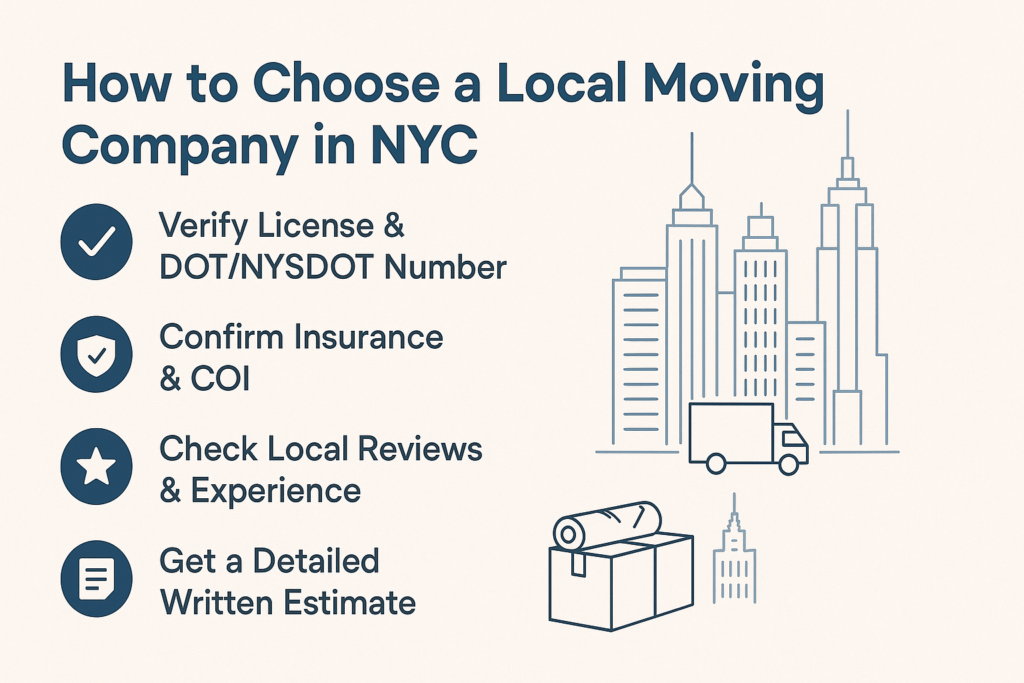
To choose a local moving company in NYC, start by defining your move details, then shortlist licensed and insured movers with strong local reviews, ask for at least three written quotes, compare what’s included, and rule out any company that uses vague pricing, pressure tactics, or refuses to show proper documentation.
Why choosing the right NYC local mover matters
Local moves in New York City are “short-distance” on paper, but they are rarely simple. Narrow streets, walk-ups, elevator reservations, strict building rules, and loading dock schedules can turn a basic move into a logistical puzzle.
The right NYC moving company:
- Knows how to work with doormen, supers, and building managers
- Can obtain and send certificates of insurance (COIs) quickly
- Brings the right crew size, tools, and truck for your block and building
- Protects your belongings and your time with clear, written agreements
A bad choice does the opposite: missed arrival windows, surprise fees, damaged furniture, or even no-shows on moving day. That’s why you need a structured way to evaluate local movers before you sign anything.
What should I look for in NYC movers?
When you’re comparing local moving companies in New York City, focus on concrete, verifiable signals rather than flashy branding or the lowest advertised price.
Local NYC experience and specialization
Prioritize movers who specialize in NYC local moves, not just “moving anywhere.”
Look for:
- Proven experience with walk-ups, brownstones, and high-rise buildings
- Familiarity with neighborhoods like Manhattan, Brooklyn, Queens, the Bronx, and Staten Island
- Reviews that specifically mention successful moves in buildings similar to yours
Local specialization usually means the crew already understands:
- Street parking realities on your block
- Building load-in restrictions and elevator reservations
- Time-of-day traffic patterns that can affect your move window
Trained crews, equipment, and protection
A serious NYC mover brings more than just a truck and muscle.
Expect them to use:
- Floor runners, corner guards, and door jamb protectors
- Moving blankets, shrink wrap, and tape included in the rate (or clearly itemized)
- Dollies, hand trucks, and sometimes hoisting solutions where needed
- Proper tools to disassemble and reassemble furniture
Ask if the company uses in-house, trained crews or casual day labor. Consistent, in-house crews tend to be more careful and efficient.
Transparent pricing and written estimates
NYC movers typically charge either:
- Hourly (with a minimum number of hours), or
- Flat-rate (based on a detailed inventory and access conditions)
What you’re looking for is clarity, not just a low number. A good written estimate will spell out:
- Crew size and estimated hours (for hourly jobs)
- What’s included: truck, fuel, basic protection, disassembly/reassembly
- Additional charges: stairs, long carries, heavy items, overnight storage, tolls, parking tickets (if any)
- The type of estimate: non-binding, binding, or flat-rate
If a company refuses to put the estimate in writing or only gives a vague “ballpark,” move on.
In-building logistics support and COIs
NYC buildings often require:
- Certificate of insurance (COI) listing the building owner and management
- Set elevator reservation time windows
- Specific move-in/move-out rules and fees
Ask the mover:
- “Can you provide a COI with my building listed as additionally insured?”
- “How far in advance do you need building details to prepare paperwork?”
- “Have you moved people in/out of my building or management company before?”
A mover who handles COIs and building coordination daily will make your life easier.
How can I check if a moving company in New York is licensed and insured?
You should never book a mover until you verify their license and insurance. This is your primary defense against scams and unqualified operators.
Verifying DOT and New York State licenses
In NYC, a legitimate moving company will typically have:
- A U.S. DOT number (for interstate authority and identification)
- A New York State DOT or local authority for intrastate moves
Ask directly:
- “What is your USDOT number?”
- “What is your NYDOT or license number for local moves?”
Then search those numbers on the appropriate government sites to confirm they match the company name, address, and status the mover claims.
If the mover dodges the question, tells you licenses are “not needed for local jobs,” or the numbers they give you pull up a different business, that’s a major red flag.
Confirming liability and cargo insurance
License alone doesn’t protect your belongings—insurance does.
Ask for proof of:
- General liability insurance (covers property damage to the building)
- Cargo insurance (covers your belongings in transit)
- Workers’ compensation (covers injuries to the crew)
A reputable NYC mover can:
- Email you their insurance certificates
- Provide sample COIs from previous jobs (with private details redacted)
If your building requires a COI, share the management’s exact requirements with the mover so they can confirm they can meet them before you book.
Certificates of insurance (COIs) for buildings
Many NYC buildings will not let movers in without a COI.
Confirm with the company:
- How quickly they can generate a customized COI
- Whether there is a fee for COI issuance (many reputable movers do it at no extra cost)
- If they understand your building’s insurance wording and limits
If the mover sounds confused about COIs, you’re likely dealing with a company that doesn’t work regularly in NYC buildings—high risk on moving day.
How many quotes should I get from local moving companies in NYC?
The short answer: three well-detailed quotes is usually the sweet spot in New York City.
Why three written quotes is a good baseline
With only one quote, you have no benchmark. With two, you can see a range, but three gives you a clearer picture of:
- Average market pricing for your type of move
- Which company is underbidding or overcharging
- How different movers define “included” vs “extra”
When you request quotes, provide the same information to each company:
- Exact addresses and floor numbers
- Elevator vs walk-up, building rules, and COI requirements
- Approximate inventory (or let them do a virtual/video walk-through)
- Any special items: large sofas, pianos, safes, delicate artwork, etc.
This ensures you’re comparing like-for-like, not apples to oranges.
How to compare NYC moving quotes fairly
When your quotes arrive, compare:
- Total estimated cost and what it includes
- Crew size and estimated time
- Type of estimate (hourly vs flat-rate, binding vs non-binding)
- Extra fees that might apply (stairs beyond a certain floor, long carries, fuel, tolls, parking)
- Professionalism of the document (clear terms, company info, branding)
Do not automatically pick the cheapest. If one quote is significantly lower than the others, ask:
- “What makes your quote so much lower than competitors for the same details?”
Sometimes it’s efficiency; often it’s corners being cut that you will feel on moving day.
What red flags signal a bad moving company in NYC?
Spotting trouble early can save you from a disaster.
Here are major red flags specific to New York City local moves:
- No license or insurance details
They dodge questions about DOT numbers or insurance, or refuse to provide proof. - Cash-only or large upfront deposits
Asking for a big cash deposit or payment in full before the move is a serious warning sign. - No physical address or only a vague location
The company lists only a cell number and generic metropolitan area with no real office. - Vague or verbal-only quotes
They refuse to send a written estimate and say “we’ll figure it out when we get there.” - Name confusion and multiple brand identities
The name on the truck, website, and contract don’t match, or they use generic names that are hard to trace. - Pushy sales tactics
They pressure you to book “right now” or claim the price is only valid for a few minutes. - Terrible online patterns
Repeated complaints about no-shows, damaged items, or hostage-style extra charges upon delivery.
If you see more than one of these signs, keep looking. NYC has plenty of legitimate movers; you don’t need to gamble on a risky one.
How do I choose a local moving company in NYC? (Step-by-step checklist)
Use this simple checklist to move from “overwhelmed” to “booked with confidence.”
Step 1: Define your move clearly
Write down:
- Move date (or date range) and flexibility
- Current and new addresses, floor numbers, elevator vs walk-up
- Rough inventory (rooms, large items, fragile items)
- Any special building rules or COI requirements
This helps movers give accurate quotes and shows you who actually reads your details.
Step 2: Build a shortlist of NYC movers
Find companies by:
- Local search (“local moving companies NYC,” “Bronx movers,” etc.)
- Google Maps listings with detailed reviews
- Recommendations from friends, coworkers, or your building staff
Create a shortlist of three to five companies that:
- Have consistent branding and a legitimate website
- Show a local NYC address and phone number
- Have a strong base of recent, detailed reviews
Step 3: Verify licenses and insurance
Before you even talk price:
- Request their USDOT and New York State license numbers
- Ask for proof of liability, cargo, and worker’s comp insurance
- Confirm they can issue a COI that meets your building’s requirements
Anyone who hesitates at this stage doesn’t make the cut.
Step 4: Request detailed written quotes
Give each mover the same information and ask for:
- A written estimate with crew size and estimated hours (or a clear flat-rate)
- Explanation of what is included vs extra
- Clarification of how they handle parking, tolls, and building time windows
Ask if they can do a video or in-home walk-through for more accurate pricing, especially for larger apartments or complex access.
Step 5: Compare value, not just price
When the quotes arrive, compare:
- Professionalism and completeness of the estimate
- Company responsiveness and clarity in answering your questions
- Their experience with buildings like yours
Often the best choice is the mover who is:
- Not the cheapest
- Not the most expensive
- The most transparent, prepared, and experienced
Step 6: Confirm building logistics and COIs
Before booking:
- Share your building’s move-in/move-out rules with the mover
- Confirm elevator reservation times and loading dock access
- Make sure they will send the COI directly to your building on time
This step avoids last-minute cancellations or delays at the door.
Step 7: Lock in your date and get everything in writing
Once you decide:
- Confirm date, arrival window, and scope in writing
- Review contract and terms before you sign
- Keep a copy of all emails and documents in a single folder
Now you’re booked with clarity and leverage if anything goes wrong.
FAQs about choosing local movers in New York City
Is it worth hiring movers for a short NYC move?
Yes, especially if you have stairs, heavy items, strict building rules, or limited time. In NYC, the logistics are often more taxing than the distance.
Should I tip my NYC movers?
Tipping is customary if the crew does a good job. Many people tip 15–20% of the labor cost, or a set amount per mover, depending on complexity.
How early should I book a local NYC mover?
Ideally 3–4 weeks in advance, and even earlier for peak dates (end of month, weekends, and summer).
Can I save money by moving on a weekday?
Often yes. Many NYC movers are busier on weekends and may have more flexibility or better rates on weekdays.
Do NYC movers pack for you?
Many do. Ask about full-service packing, partial packing (kitchen, fragile items), or just labor for loading what you packed yourself.
Why a company like 5 Star Movers NYC fits these criteria
When you apply the checklist above, the right NYC mover will stand out because they:
- Are fully licensed and insured for local New York moves
- Understand borough-to-borough logistics, walk-ups, and high-rise rules
- Provide clear, written estimates with no games around pricing
- Handle COIs and building coordination as part of their normal process
- Have a track record of detailed, recent reviews from local customers
That combination—paperwork, experience, equipment, and honest communication—is exactly what you should be looking for when choosing a local moving company in NYC.
Get a clear, no-nonsense NYC local moving quote
If you’re planning a local move anywhere in New York City, don’t wait until building calendars fill up or your preferred date disappears.
- List your addresses, building details, and move date
- Decide whether you want packing help or just loading and transport
- Reach out to your top choice of mover and request a detailed, written quote
Follow the steps in this guide, and you’ll move with a company that shows up on time, respects your building, protects your belongings, and charges the price you were expecting—nothing more, nothing less.
Plan Your NYC Move
Explore our Local Movers NYC, see our NYC service areas, or request a free quote. You can also visit the 5 Stars Movers NYC home page for more tips.
