

Understanding how much movers charge per hour in NYC helps businesses build realistic budgets and avoid surprise invoices on move day. Companies that partner with 5 Stars Movers NYC in New York City, NY for commercial moving can compare hourly rates, services, and options against a clear pricing framework before they commit.
New York City is a high cost market, so commercial moving rates reflect local labor costs, building rules, parking restrictions, and travel time. Unlike national averages, NYC office moves are shaped by elevator bookings, loading dock windows, and the time it takes to move items between street and suite.
This guide explains typical hourly pricing for commercial movers, how charges are calculated, common extra fees, and how to reduce your total spend without cutting corners on safety or compliance.
Overview of commercial moving costs in NYC
Commercial moving costs in New York City are usually built from several components:
- Hourly labor for movers and supervisors
- Use of a truck or multiple trucks
- Materials such as boxes, shrink wrap, and floor protection
- Travel time from the warehouse to your building and back
- Access related charges such as long carry or stair work
- Optional services such as packing, IT handling, or after hours work
For office and commercial moves, costs are usually quoted after a walkthrough or virtual survey so the mover can understand:
- Square footage and layout of the current and new space
- Elevator access and loading dock rules
- Security or certificate of insurance requirements
- Furniture systems, IT equipment, and specialty items
- Required schedule such as night or weekend work
Regulators like the Federal Motor Carrier Safety Administration (FMCSA) publish guidance on consumer rights, valuation, and documentation, which also influences how reputable movers structure pricing and contracts for local and interstate moves. fmcsa.dot.gov+1
How much do movers charge per hour in NYC?
Most commercial movers in NYC charge an hourly rate that usually falls in a band of about 140 to 250 dollars per hour for a small crew with a truck, with higher rates for larger crews, complex buildings, or premium time slots such as weekends and nights. Angi+1
That hourly rate normally covers:
- A specific crew size, such as 3 or 4 movers
- One truck and standard moving equipment
- Basic protective materials like pads and floor runners
- A minimum number of billable hours
Industry data for local and commercial moves shows that hourly charges are often based on a rate per mover that is then multiplied by crew size and adjusted by market conditions. For example, a general commercial moving reference range of 25 to 125 dollars per mover per hour is commonly cited across U.S. markets, with New York City at the upper end because of labor and access challenges. The Armstrong Company+1
In practice, businesses in Manhattan and the outer boroughs may see proposals such as:
- 3 movers and a truck at 180 to 220 dollars per hour
- 4 movers and a truck at 220 to 280 dollars per hour
- Additional movers billed at 40 to 70 dollars per hour each
Rates can also be higher for very tight time windows or for work that must be completed overnight in Class A office buildings.
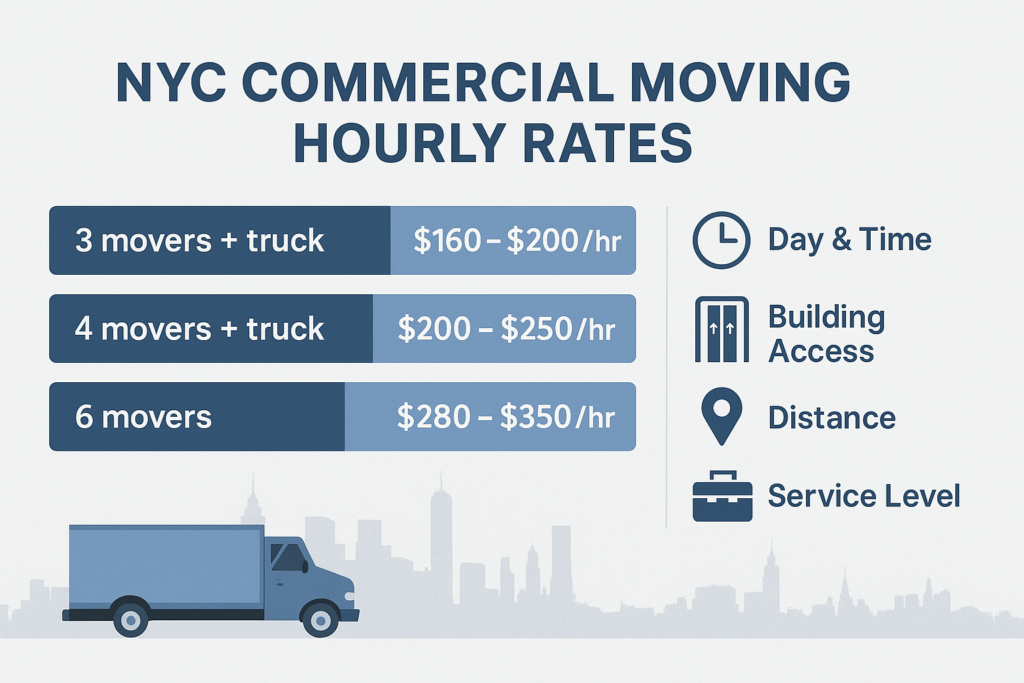
Typical hourly rates for NYC commercial movers
While each mover sets its own pricing, typical patterns for hourly rates in NYC look like:
- Small office or retail space
- 2 to 3 movers, 1 truck
- 150 to 220 dollars per hour
- Medium office, professional services firm, or clinic
- 3 to 5 movers, 1 or 2 trucks
- 200 to 320 dollars per hour
- Larger office, multiple departments, or light industrial space
- 6 or more movers with multiple trucks
- Custom hourly rate or a blend of hourly and flat pricing
These figures assume local moves within New York City and are based on current ranges for professional movers operating in high cost metropolitan areas. Angi+1
If your move involves heavy items, complex disassembly, or multiple stops, the mover may recommend a larger crew at a correspondingly higher hourly charge so the work can be completed within building time limits.
Factors that raise or lower hourly pricing
Several factors affect where your quoted rate will fall within the typical NYC range:
- Day and time
- Nights, weekends, and holidays are often more expensive.
- Early morning or late night slots may require overtime rates.
- Access complexity
- Walk ups, limited elevators, or very long carries increase labor time.
- Tight loading docks and limited truck parking add delays.
- Building requirements
- Certificates of insurance, union labor, and security escorts can add cost.
- Strict building rules may require extra crew to meet time windows. 5 Stars Movers NYC
- Service level
- Full packing and unpacking costs more than load and unload only.
- IT disconnect and reconnect services add specialist labor.
- Seasonality
- Late spring through early fall is peak moving season in New York.
- End of month and end of quarter dates tend to be busier.
Because these variables are specific to NYC buildings and neighborhoods, a written quote based on a detailed survey is usually more accurate than a generic online estimate.
How are commercial moving rates calculated?
Commercial moving rates in NYC are typically calculated by combining crew labor, trucks, travel time, and estimated project duration into one hourly or flat price that aligns with local building rules and business needs.
Most commercial estimators follow steps like these when building a quote:
- Estimate total labor hours
- Calculate how long it will take to pack, load, transport, unload, and set up.
- Factor in elevator waits, loading dock constraints, and walk distances.
- Determine crew size and roles
- Assign the right number of movers plus a lead or supervisor.
- Add specialists for IT, furniture systems, or fragile equipment if needed.
- Add trucks and equipment
- Decide how many trucks and which size vehicles will be used.
- Include dollies, panel carts, library carts, and protection materials.
- Include travel and staging time
- Add time for mobilization, travel between locations, and demobilization.
- Apply hourly rates or create a flat price
- Multiply estimated hours by the blended hourly rate.
- Adjust for risk, complexity, and required time windows.
Reputable movers will explain what is included in the base rate and what is billable as an extra so you can compare quotes accurately.
How much does it cost to move an office in NYC?
A typical small office move in NYC may cost from a few thousand dollars to tens of thousands of dollars for larger or multi phase projects, depending on size, access, and scope. For many businesses, total costs for a local office move can range from roughly 3,000 to over 50,000 dollars once all services are included.
To estimate your own cost, consider:
- Office size and headcount
- Number of workstations, private offices, and shared areas
- Volume of paper files, samples, or inventory
- Furniture and equipment
- Cubicles and systems furniture that must be dismantled and rebuilt
- Servers, network racks, copiers, and specialized machinery
- Scope of services
- Whether the mover is packing contents or only handling furniture
- Whether you need weekend or overnight work to avoid downtime
- Distance and logistics
- Distance between buildings
- Parking, loading dock, and elevator constraints
Public resources such as the NYC Department of Small Business Services and its commercial leasing guides offer additional context on occupancy costs and planning considerations for companies relocating within the city. New York City Government+1
Because office moves intersect with lease timelines, IT cutovers, and staff scheduling, businesses often phase work over several nights or weekends. This can raise the total cost while keeping operations running.
Do commercial movers charge extra fees in NYC?
Commercial movers in NYC often charge extra fees for conditions that significantly increase time, risk, or resources, and these charges are typically listed as access or service surcharges on the estimate and final invoice.
Common examples include:
- Long carry charges
- When movers must carry items more than a set distance from truck to suite.
- Stair carry charges
- When there is no elevator or when items are too large for the elevator.
- Shuttle truck or parking challenges
- If the main truck cannot park close to your building, smaller vehicles may be needed.
- After hours or weekend premiums
- Many commercial buildings require moves outside business hours.
- Labor rates and building operating costs are usually higher at night.
- Special handling fees
- For safes, large copiers, lab equipment, or high value electronics.
- Change orders and overruns
- Additional items not shown during the survey.
- Floor plan changes that require rework of furniture layouts.
New York City buildings frequently require certificates of insurance and proof of coverage, and movers may fold administrative and compliance work into their base rates or list it as a separate line item. fmcsa.dot.gov+1
Understanding these potential add ons helps you negotiate scope, schedule, and access conditions before signing a contract.
Flat rate vs hourly commercial moving quotes
Commercial moves in NYC can be priced as pure hourly, pure flat rate, or a hybrid where some tasks are flat and others are hourly. Each approach has trade offs.
Hourly pricing works well when:
- Scope is small or flexible
- You expect changes on move day
- Building rules are straightforward
Advantages:
- You pay for the actual time worked.
- It is easy to see how added tasks affect the bill.
Risks:
- Poor planning can cause overruns.
- Seasonal traffic or elevator delays can increase hours.
Flat rate pricing can make sense when:
- Scope is well defined after a detailed survey
- You want cost certainty for a fixed list of tasks
- The mover has strong experience in similar projects
Advantages:
- Easier to budget and compare proposals.
- The mover is incentivized to work efficiently.
Risks:
- Change orders can be costly.
- Some services may be excluded from the flat price.
Many NYC businesses choose a hybrid model in which core work is flat rated but packing, overtime, or additional stops are billed hourly at agreed rates.
When hourly pricing makes sense for businesses
Hourly pricing tends to work best for:
- Smaller offices with modest furniture and contents
- Moves within the same building or complex
- Projects where staff will do some of the packing themselves
- Situations where the building has flexible access and loading
If you intend to provide your own packing labor, you can coordinate with moving labor only services such as the moving labor help team to handle loading and unloading while keeping packing work in house. 5 Stars Movers NYC
How to estimate your NYC office move budget
A practical approach to estimating an office move budget in NYC is to combine a bottom up view of hours and crew size with a top down view of what similar businesses have spent.
A simple framework looks like this:
- Define your move profile
- Office size, number of staff, and type of work.
- Locations of old and new spaces, including boroughs.
- Estimate labor hours and crew size
- Use information from movers or online guides to rough in hours.
- Multiply estimated hours by likely hourly ranges for crew size. The Armstrong Company+1
- Add materials and special services
- Consider costs for boxes, crates, and specialty packing.
- Add separate lines for IT, furniture systems, or special equipment.
- Include soft costs and contingencies
- Budget for staff time, temporary space, and possible overlap rent.
- Add a contingency, often 10 to 20 percent, for unknowns.
- Test the budget with quotes
- Request detailed commercial moving quotes from providers.
- Compare inclusions, exclusions, and assumptions side by side.
As you refine your plan, resources from NYC Small Business Services and its commercial leasing guide can help you align move timing with lease expiration, tenant improvement work, and new landlord requirements. New York City Government+1
How can I reduce my commercial moving costs?
Businesses can reduce commercial moving costs in NYC by minimizing billable hours, limiting change orders, and using in house resources where appropriate, while still complying with building rules and safety standards.
Concrete tactics include:
- Right size the crew
- Work with the estimator to match crew size to scope.
- Avoid oversizing the crew just to feel safer.
- Declutter before the move
- Dispose of obsolete files, broken furniture, and unused inventory.
- Fewer items mean fewer hours and less truck space.
- Pack strategically
- Have staff pack personal contents and clearly label boxes.
- Reserve professional packing for fragile or high value items.
- Book off peak dates where possible
- Midweek and mid month dates can be less expensive.
- Avoid peak summer weekends if your lease allows.
- Plan building access carefully
- Reserve elevators and loading docks well in advance.
- Provide clear floor plans and labeling to reduce confusion.
You can also review educational material on consumer rights and valuation from FMCSA, as well as IRS guidance on whether any move related costs are deductible as business expenses under current law. fmcsa.dot.gov+1
NYC commercial moving cost questions answered
Q: Are hourly moving rates negotiable in NYC?
A: Hourly moving rates in NYC are sometimes negotiable, especially for midweek or off peak moves, but reputable movers are more likely to adjust scope or crew size than to deeply discount their published rates.
Q: Are hourly moving rates negotiable in NYC?
A: Many movers will discuss rate options if you are flexible on dates, service level, or crew size. Some will lock in a lower hourly rate in exchange for a higher minimum number of hours or for booking during less busy periods.
Q: How much should I budget for tipping NYC movers?
A: For commercial moves, tipping is usually structured as a lump sum that is shared across the crew, and many businesses budget 4 to 8 percent of the move labor cost, adjusted for service quality and corporate policies.
Q: How much should I budget for tipping NYC movers?
A: Some companies include a line in their internal budget for gratuities, then decide the final amount after the move based on punctuality, care for property, and how well the crew worked with building staff. Always follow your company policy on tipping.
Q: Do NYC movers charge for travel time to and from my building?
A: Many NYC movers charge for travel time from their warehouse to your building and back, and this time is often billed at the same hourly rate as on site work or included in a minimum number of hours.
Q: Do NYC movers charge for travel time to and from my building?
A: It is common to see one hour of travel time added to local commercial moves, but this can vary based on distance and traffic. Ask whether travel time is included in the minimum or listed as a separate line so you can compare quotes fairly.
Q: What is the minimum number of hours movers usually charge?
A: Commercial movers in NYC often have a minimum of 3 to 5 billable hours, which covers travel time, setup, and a reasonable amount of on site work for the crew and truck.
Q: What is the minimum number of hours movers usually charge?
A: A small project that only requires 2 hours on site may still be billed at a 4 hour minimum to cover the costs of dispatching a truck and crew. If your move is very small, ask whether you can combine tasks or share a crew between locations.
Q: How early should I book movers to lock in a lower rate?
A: Booking commercial movers in NYC 4 to 8 weeks in advance for small moves and 3 to 6 months ahead for larger projects improves your chances of securing favorable dates and rates, especially outside peak season.
Q: How early should I book movers to lock in a lower rate?
A: When you book early, you can compare multiple proposals, negotiate scope, and avoid premium pricing for last minute dates. For large office relocations, reserve movers as soon as lease terms and construction timelines are clear.
Q: Do movers in NYC offer discounts for off peak days?
A: Some movers offer modest discounts for moves scheduled on non peak days, such as midweek or mid month, especially during slower seasons, although building access rules may limit how much you can shift dates.
Q: Do movers in NYC offer discounts for off peak days?
A: Ask movers whether they have preferred windows where crews are more available, then see if those windows align with your lease and building elevator schedules. Even a small reduction in hourly rates can translate into material savings on large projects.
Q: Can I combine hourly labor and flat rate services for one move?
A: Many movers will combine flat pricing for clearly defined tasks with hourly pricing for variable work, providing cost certainty on core services while leaving flexibility for changes and additional phases.
Q: Can I combine hourly labor and flat rate services for one move?
A: For example, you can negotiate a flat price for packing and transporting core office contents while leaving tasks such as clearing storage rooms or disposing of surplus furniture on an hourly basis. Clarify how added tasks will be authorized and billed.
Request a precise NYC commercial moving quote in New York City
Once you understand hourly rate ranges and cost drivers, the next step is to request detailed quotes that match your actual office layout, inventory, and schedule.
To get the most accurate proposal:
- Share floor plans and photos of current and new spaces.
- Provide a list of furniture, IT equipment, and special items.
- Explain building rules, elevator reservations, and loading dock hours.
- Indicate whether you need packing, unpacking, or IT services.
You can start by reviewing the commercial moving services overview and then requesting a written quote that spells out crew size, hourly rate, minimum hours, and what is included in the price.
If your relocation involves cross state moves or complex logistics, it can also be useful to explore options from the long distance movers team and to combine full service moving with targeted moving labor help for tasks such as loading storage units or handling satellite offices. 5 Stars Movers NYC+35 Stars Movers NYC+35 Stars Movers NYC+3
For businesses with multiple New York City locations, consider how this framework applies to moves in nearby neighborhoods such as the East Village, Alphabet City, Lower East Side, Tribeca, and other boroughs served by the company, so you can standardize budgets and expectations across your entire portfolio.
Plan Your NYC Move
Explore our Local Movers NYC, see our NYC service areas, or request a free quote. You can also visit the 5 Stars Movers NYC home page for more tips.
